Proposal
Problem
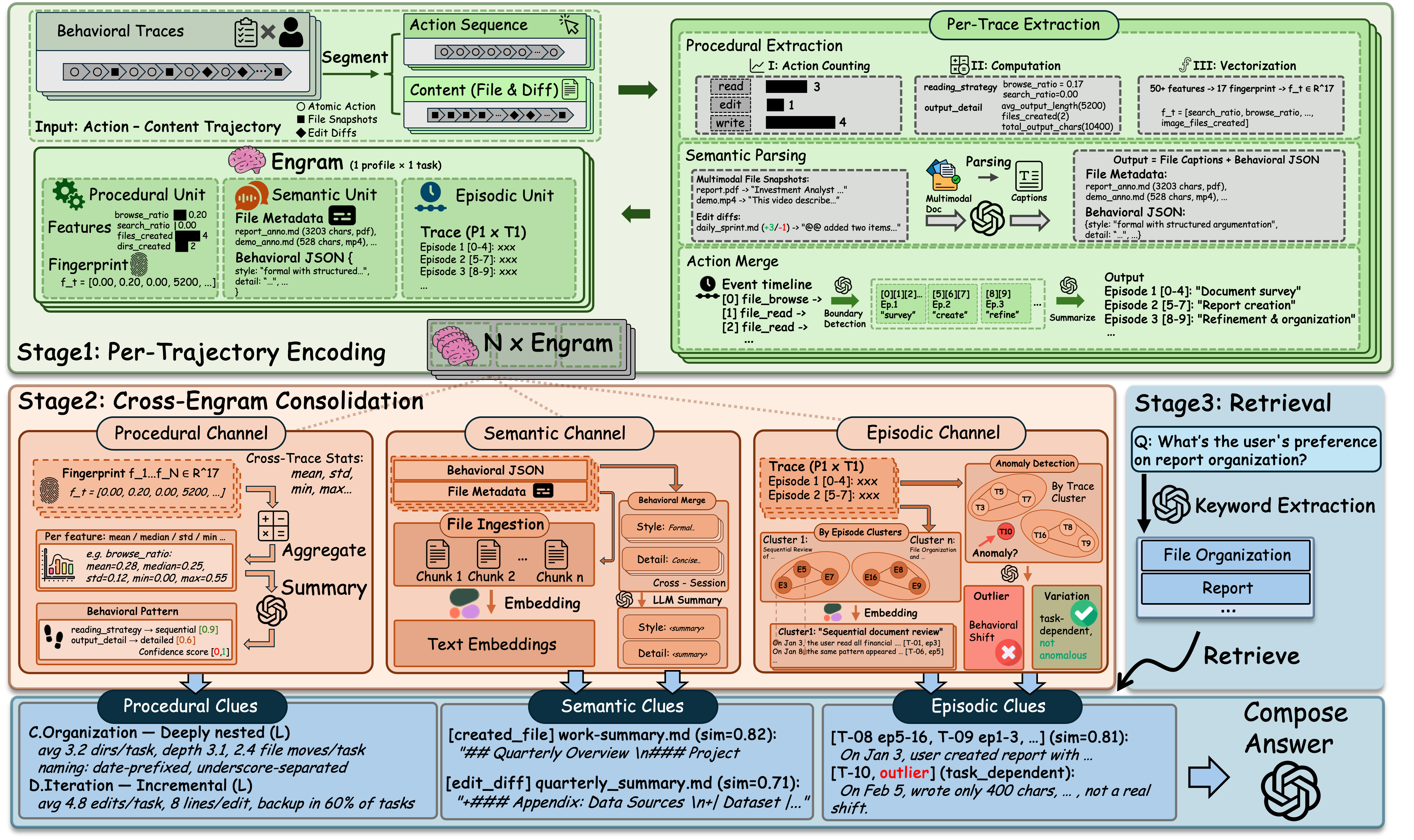
A personal agent can write that a user "prefers concise reports," but a profile sentence alone does not reveal where that belief came from, when it was true, or whether it should still influence an action. Personalization built on unattributed summaries cannot be questioned, corrected, or safely reused. FileGram asks: can personal memory be derived from behavioral evidence — everyday file activity — so that the path from behavior to memory to assistance stays visible end to end?
Current work
- Profile-based personalization (assistant memory features, persona-conditioning methods) stores write-once summary sentences: no provenance, no validity window, no update discipline when behavior changes.
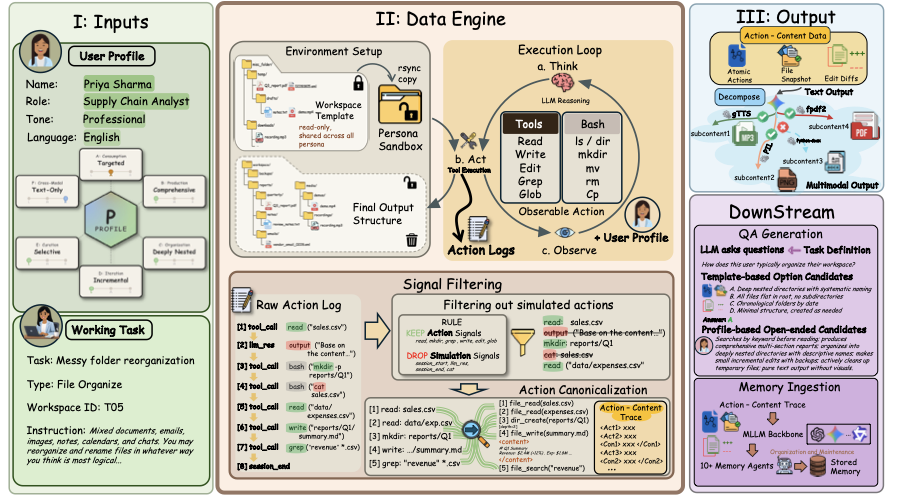
- Lifelong / agentic memory systems optimize what to store and how to retrieve, but the substrate is conversation logs — the agent remembers what was said, not what the user did, and the evidence behind a memory is rarely representable at all.
- Digital-activity mining (desktop telemetry, file indexing, activity logging) captures behavior at scale but stops at search and analytics; nobody closes the loop from activity streams into agent-usable, inspectable memory.
Why significant
- Provenance is the missing property of personal memory. Every FileGram memory carries its evidence — which files, which activity pattern, over which time window — so a belief about the user is auditable and contestable rather than an opaque assertion. This is the property that makes personalization correctable: a user who disagrees with a memory can inspect exactly why the system holds it.
- File activity is the highest-leverage behavior stream nobody uses. It is universal (every knowledge worker produces it), passive (no new sensors, no new habits), semantically rich (projects, collaborators, rhythms, tool choices), and locally negotiable for privacy. Grounding memory here demonstrates evidence-based personalization without any exotic hardware.
- Evidence-grounded state is the precondition for honest downstream research. Once memory has provenance, the next questions — what to retrieve, when to intervene, how much authority to exercise — can be studied with attribution instead of anecdotes. FileGram supplies the grounded-state layer that MMSkill-RL's routing policy and the survey's loop-closure audit both presuppose: evidence-grounded state → learned consultation policy → auditable closed loop, one trilogy.
- It reframes the trust conversation for deployed agents. "The agent knows you" becomes reviewable infrastructure: memory with citations, not vibes. That is the difference between personalization users tolerate and personalization users can actually govern.