Can a visual agent learn when to act directly, invoke a text skill, use a visual skill, or combine both?
Proposal
Problem
Small VLMs powering GUI agents fail on the long tail of software interactions — the menu paths, dialog sequences, and app-specific conventions that larger models absorb parametrically. An external multimodal skill memory (procedural text cards + visual exemplars mined from demonstrations) can supply the missing knowledge, but consulting it is not free: evidence costs tokens and latency, and the useful modality varies per step. The learning problem is therefore not "can the model use a skill once given" but can a weak model learn when to consult which modality — DIRECT / QUERY_TEXT / QUERY_IMAGE / QUERY_BOTH — from its own outcomes.
Current work
GUI agents (UI-TARS, CogAgent, the Qwen-VL GUI line; OSWorld / AgentNet benchmarks) attack the long tail by scaling parametric knowledge inside the policy. There is no consultation action; a knowledge gap is a capability gap.
RAG and tool-use routing treat retrieval as text-centric and usually always-on or heuristically gated. The few works that learn a "retrieve or not" decision imitate a strong model's choices — which is confounded, because what a strong model can solve directly says nothing about what the student should attempt directly.
Skill-library agents (Voyager-style accretion, demonstration mining) grow the library but assume retrieval is free and always beneficial; none measures per step whether a skill was causally necessary.
The missing piece across all three: no benchmark labels each step with which evidence modality actually rescues it, so modality-level routing can be neither trained honestly nor evaluated at all.
Why significant
This is where the paper lives — five claims, each load-bearing:
It isolates the decision, not the capability. The counterfactual matrix (41,116 steps × 4 conditions under a strong model) gives every training step a ground-truth need profile: 14.3% are rescued only by skills, 6.6% specifically need visual evidence, 43% need nothing, 42.7% are covered by nothing. Once these numbers exist, "when to consult" stops being an anecdote and becomes a measurable quantity — and every fixed policy is provably suboptimal at both ends (always-query burns cost on the 43%; never-query forfeits the 14.3%).
It is the first clean testbed for modality-level routing. Evidence construction v2 makes modality the only variable: all skill conditions share the same top-2 packages, exemplar budget, and token budget. Any Text/Image/Both performance gap is attributable to modality utility rather than retrieval breadth — the confound that silently invalidates naive comparisons.
It demonstrates the SFT ceiling empirically, not rhetorically. Our 2026-08-20 eval shows supervised exposure produces routing that is diverse but non-discriminative — the decision distribution is healthy yet uncorrelated with whether a step needs evidence. This is a reusable negative result: imitation can teach format and evidence-conditioned execution, but it cannot teach when, because the supervision itself cannot know what the student needs.
RL closes exactly the gap that the analysis exposes. Outcome + query-cost reward over the student's own rollouts is the only signal that is about the student. If the RL stage lifts accuracy at equal or lower consultation cost — or matches accuracy at ≥30% lower cost — the paper establishes that when-to-consult is learnable from outcomes. The mechanism is general: deferral, tool-call gating, and retrieval triggering are the same decision wearing different clothes; GUI agents are the demonstration, not the boundary.
Cost-aware autonomy is the deployment story. On-device and latency-budgeted agents cannot afford always-on retrieval; a policy that knows when not to look is what makes external memory practical at the edge.
Contribution targets
A clean multimodal GUI skill pool — deduplicated, provenance-tracked, frozen.
A skill-sensitive benchmark and oracle-training signal — every step labeled by which conditions (direct/text/image/both) a strong model can solve it under.
Evidence that explicit skill use reduces none/uncovered and lifts weak-model action correctness.
An end-to-end skill-use policy — the weak model learns DIRECT / QUERY_TEXT / QUERY_IMAGE / QUERY_BOTH from its own rollouts and rewards.
Governing principle
Gemini counterfactual outcomes are a capability signal, not the weak model's routing oracle. The final policy must come from student rollouts plus reward, because what a strong model can solve directly says nothing about what the weak model should attempt directly.
This one principle shapes everything downstream: strict routing labels (6,517 steps) are used only as light exposure in SFT, never as the imitation target; the ablation grid exists precisely to prove the lift comes from RL-learned routing rather than SFT memorization.
Data & Splits
Clean split discipline
split
buckets
scale
role
skill-source
15–49
5,144 steps · 1,500 tasks
skill pool provenance
oracle-train
50–99
41,116 steps · 2,493 tasks
counterfactual matrix + RL prompts
external-final
0–14
12,564 steps · 761 tasks
held-out benchmark only
Overlap audit: 0 same-task / 0 same-step between skill pool and either training or benchmark splits.
Evidence construction v2 (parity fix, 2026-08-06)
All skill conditions now share the same top-2 retrieved packages; only the view differs (text card / visual exemplars / both). Exemplar images are materialized at reduced resolution (~301k px, ~270 tokens each) while the current screenshot keeps full resolution for grounding. This removes the retrieval-breadth confound (Both previously saw up to 6 packages) and fixes the Both-overflow pathology: under the Qwen processor, Both sequences dropped from p50 = 27.5k tokens (100% over the old 9,216 cap — effectively never trained) to p50 = 4.5k, giving 0% truncation at cutoff 8,192 across all conditions.
Frozen skill pool
text clusters
3,010 (LLM-summary clustering over AgentNet raw skills)
visual exemplars
5,144 (≤3 clean exemplars per cluster)
embeddings
8,154
Deliberately not compressed further: 56.3% of clusters have a single clean member and ~80% have at most three, so further merging would hurt retrieval coverage while only deduplicating a few high-frequency GUI patterns.
SFT (80–100K examples): format/schema ~5K · skill-conditioned action ~55K · direct action ~15–18K · light routing exposure ~6K · fallback reformats ~10–15K. Goal: legal structure, the four-way decision format, and skill-evidence-to-action generation — not routing imitation.
RL (full oracle-train): 41,116 prompts × 4 rollouts (164,464 trajectories/epoch), scaling to ×8. Weighted sampler instead of uniform: skill_rescue 3–4×, fallback 1.5–2×, direct 1×, uncovered 0.5×. Reward = format + deterministic action correctness + query cost (DIRECT < single query < BOTH) + skill-use reward only when the query improves the outcome.
Required ablations
arm
answers
RL-only
can rewards alone train format and routing?
minimal SFT + RL
main method
full SFT only
is SFT enough? (the 8-13 result already says no for routing)
full SFT + RL
does heavy imitation help or hurt RL?
The grid answers the reviewer question the project is built around: does the lift come from RL-learned skill use, or did SFT already teach the routing?
Counterfactual Matrix
Oracle-train counterfactual matrix
Every oracle-train step was run under four conditions with Gemini 3.5 Flash: 41,116 unique steps × 4 = 164,464 condition rows (42 shards, 1 error total).
condition
success
direct (no skill)
43.02%
+ text skill
45.77%
+ image skill
43.29%
+ both
45.98%
Step-level structure (what the numbers mean)
category
share
reading
skill_rescue
14.33%
direct fails, at least one skill condition succeeds — the value proposition
optional fallback
41.50%
direct succeeds but skills also succeed — cannot hard-label DIRECT for a weak model
RL rollout stack (vLLM/verl support for hybrid-attention Qwen3.5)
next
RL small debug (1–2K prompts × 4 rollouts)
next gate
Full RL (41,116 × 4 → ×8)
queued behind debug
Ablation grid (4 arms)
queued
Results
SFT vs base · SkillUseBench 4K (2026-08-13, Qwen3.5)
metric
base
SFT
Δ
end-to-end accuracy
22.6%
76.8%
+54.2 pp (95% CI [52.6, 55.8], McNemar p ≈ 0)
action validity
39.4%
100%
+60.6 pp
decision format (strict)
88.8%
100%
+11.2 pp
what-accuracy / where-accuracy
30.0 / 69.9
86.6 / 82.7
—
routing-oracle agreement
34.8%
45.0%
+10.3 pp
The red flag that matters most
Base routing spreads across DIRECT 3,111 / QUERY_TEXT 881; SFT routing collapses to QUERY_IMAGE on 4,000 of 4,000 steps, with query cost rising 0.011 → 0.080. The accuracy lift is real, but the policy learned "always fetch a visual exemplar," not when to fetch one.
This is the project's thesis confirming itself: supervised exposure teaches format and skill-conditioned action, and it does not teach routing. The routing decision has to be earned through student rollouts against outcome and cost rewards — exactly the RL stage that runs next. Discordant pairs: SFT-only-correct 2,209 vs base-only-correct 40.
Update — routing under rollout decoding (2026-08-20)
The 4,000/4,000 collapse above is a greedy-decoding artifact, not a property of the policy. The SFT data maps the same prompt to multiple "correct" decisions (one per successful counterfactual condition), so the model learns a decision distribution; greedy decoding surfaces only its mode (QUERY_IMAGE, whose constant "current_screen" query is the easiest continuation). Re-evaluated on 820 held-out RL prompts under actual rollout conditions (temp = 1.0, 4 samples each, 3,280 decisions):
metric
value
decision distribution
DIRECT 43.6 · IMAGE 36.7 · TEXT 10.4 · BOTH 9.4 — no collapse
format validity (truncation-adjusted)
99.6% (only 12/3,280 genuinely malformed)
DIRECT rows emitting inline <ACTION>
87.4%
per-category discrimination
none — direct_strict, skill_rescue, optional_fallback, none_uncovered all get near-identical distributions
Reading: the RL-rollout preconditions are green (diverse actions, valid format), and the remaining deficit is precisely the one SFT cannot fix — the decision is uncorrelated with whether the step actually needs a skill. Light routing exposure (6.5K high-confidence labels, ~7% of data) is drowned out by the 73K marginal-teaching action traces. "When to query" must come from outcome-based RL.
Training record · Qwen3.5-9B SFT (run 11, 2026-08-12)
recipe
full SFT (vision tower unfrozen) · parity-v2 data (94,644 train / 1,115 valid) · 1 epoch · global batch 128 · lr 1e-5 linear · cutoff 8,192 · ZeRO-3 on 8×A100-40G
final losses
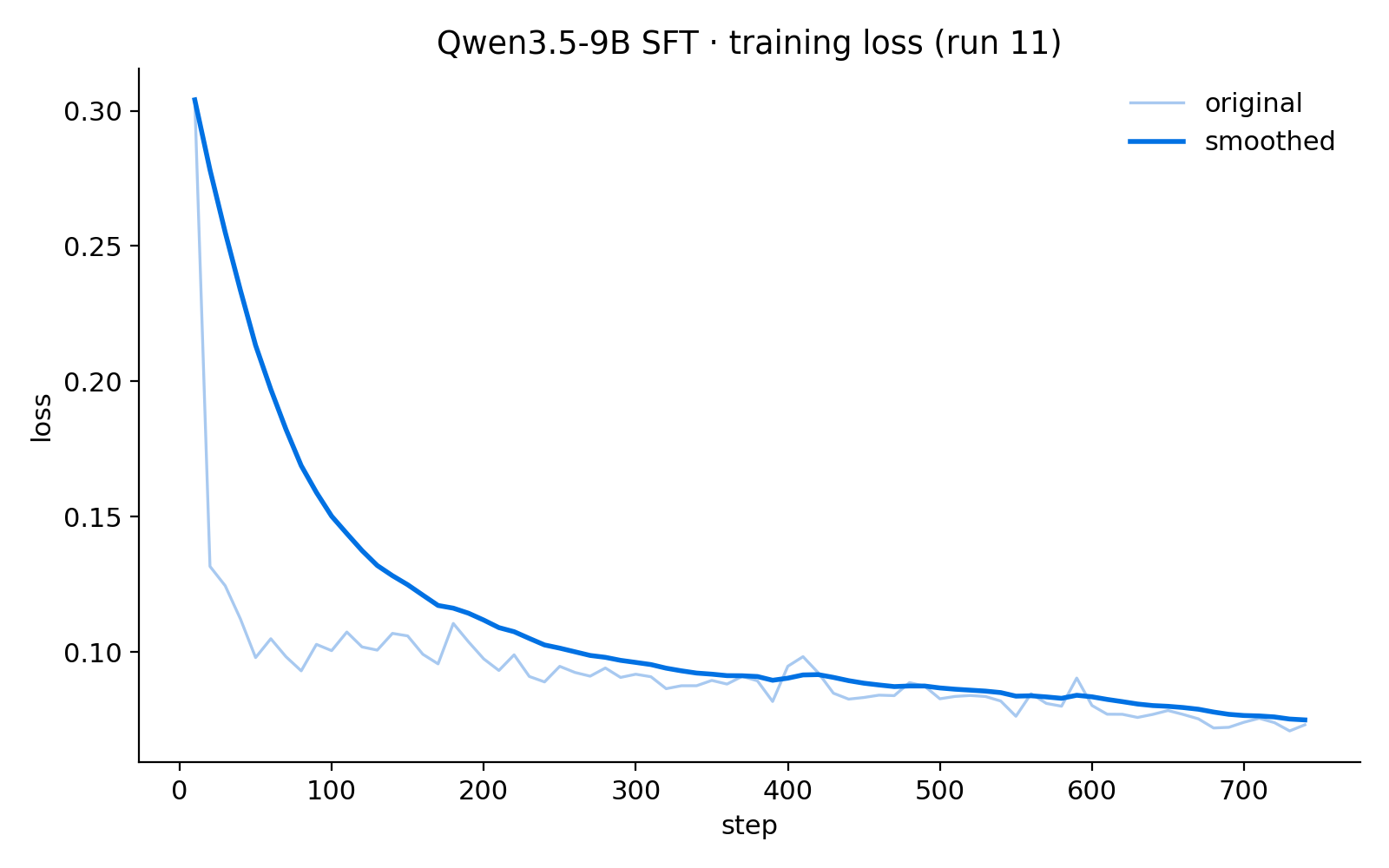
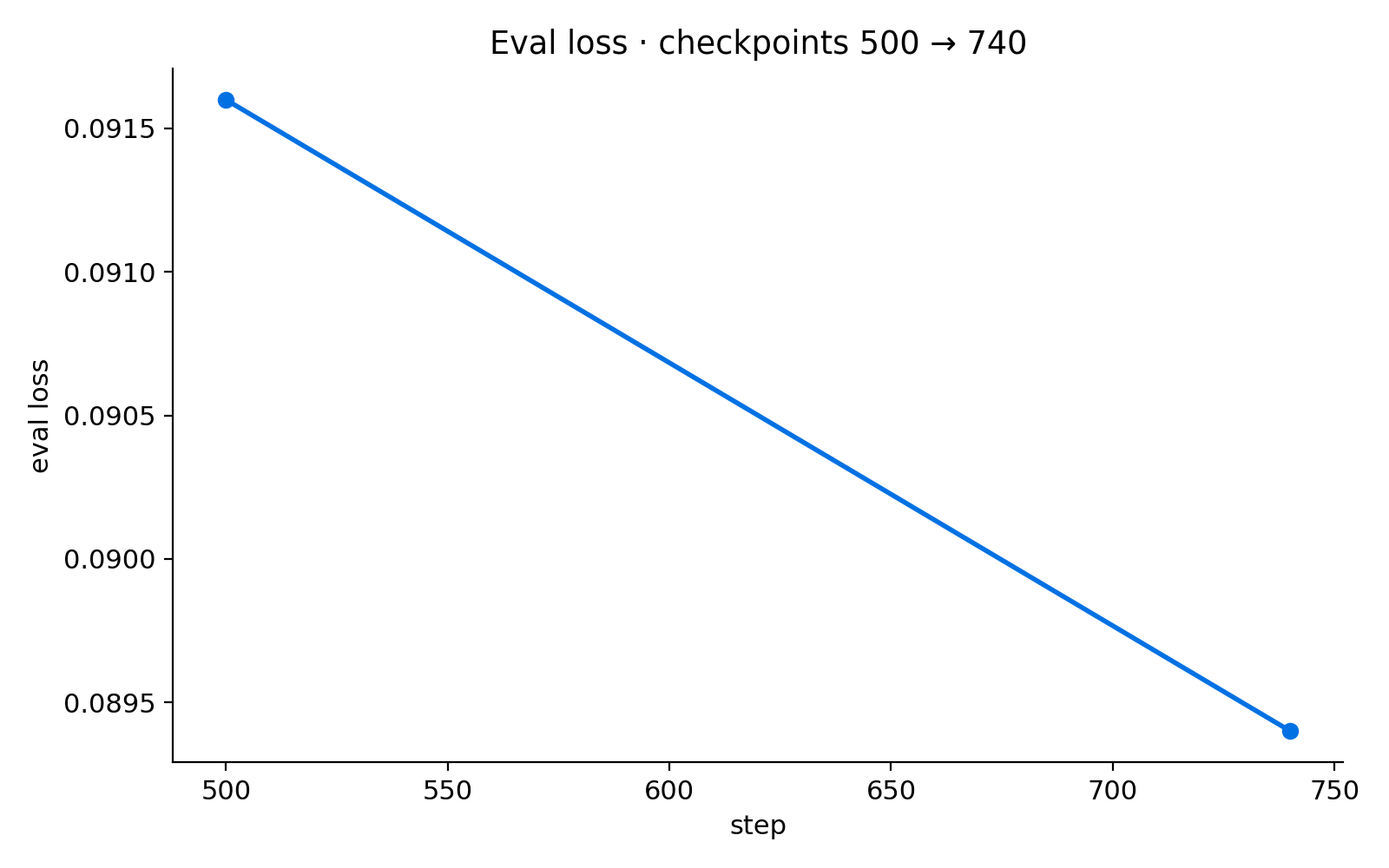
train 0.093 · eval 0.089 (still falling at the end — no overfit)
wall clock
42.5 h · 207 s/step (hybrid linear-attention fast path via flash-linear-attention)
Training loss, run 11: sharp descent through warmup, smooth convergence to 0.073 — after two earlier runs silently trained at zero gradient, this curve is the one that finally moved.Eval loss between checkpoints 500 → 740: still decreasing at the end of the single epoch.
Working draft · ICLR 2027 target
Status: skeleton + argument outline. LaTeX scaffold lives in paper_iclr2026/; sections below are the current working text, updated as results land.
Title (working)
MMSkill-RL: Learning When to Consult Multimodal Skill Memory in GUI Agents
Abstract (sketch)
GUI agents backed by small VLMs fail on the long tail of software interactions that larger models handle from parametric knowledge. We study whether an agent can instead consult an external multimodal skill memory — procedural text cards and visual exemplars mined from demonstrations — and, critically, whether it can learn when each modality of evidence is worth its cost. We (i) release a frozen, provenance-tracked multimodal GUI skill pool and a counterfactual benchmark labeling every step by which evidence conditions rescue it; (ii) show supervised fine-tuning teaches format and skill-conditioned action execution but provably fails to teach routing — the SFT policy's decision distribution is diverse yet uncorrelated with whether a step needs evidence; (iii) show outcome-based RL over the agent's own rollouts closes this gap [pending: 2K-gate + full-run numbers].
1 · Introduction (outline)
GUI agents need long-tail procedural knowledge; scaling parametric knowledge is not the only path — external skill memory is the alternative.
The hard problem is not retrieval but routing: evidence has a token/latency cost, and the useful modality varies per step (procedural text vs. visual exemplar vs. both vs. none).
Counterfactual evidence: 14.3% of steps are rescued only by skills; 6.6% specifically need visual evidence; 43% need nothing — a fixed policy is provably suboptimal at both ends.
SFT-alone result: format ✓, skill-conditioned execution ✓ (+54.2 pp), routing ✗ (distribution uncorrelated with need — Section 5).